Ahead of the wave: Regulatory change in European payments (whitepaper)


European payments are facing the most comprehensive regulatory transformation since the introduction of the SEPA area. By 2030, a wave of several key regulatory initiatives is building up, coming into force simultaneously and with tight deadlines.
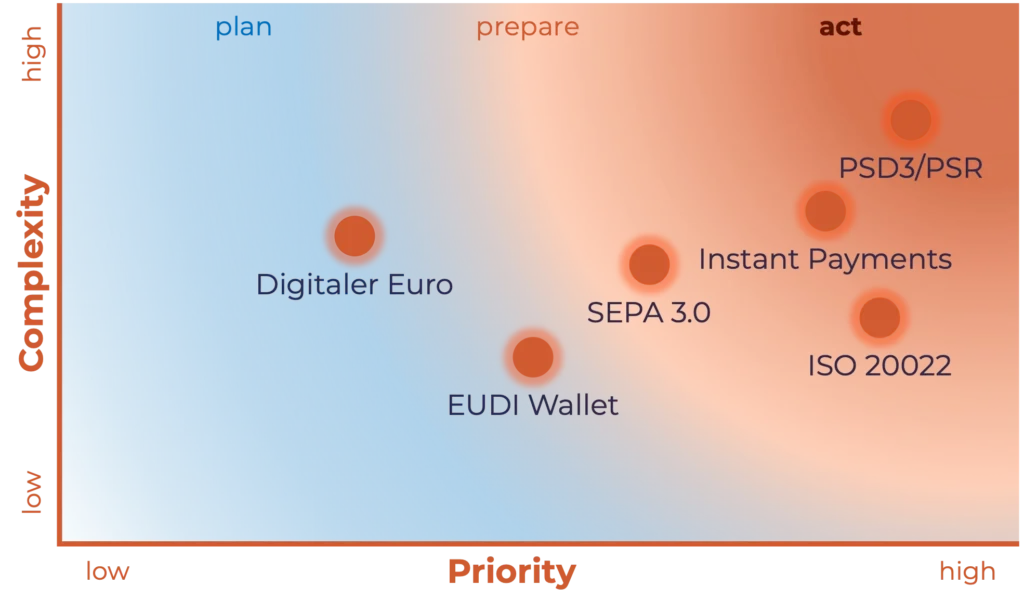
The chart above provides an assessment of the priority and implementation effort and complexity of the key regulatory initiatives in European payments. Priority evaluates how urgent and far-reaching the regulatory pressure on banks is, taking into account legal bindingness, proximity of deadlines, and strategic significance. Effort reflects the estimated implementation effort, comprising IT complexity, required process adjustments, internal resource requirements, and external dependencies.
The simultaneous implementation of these regulatory initiatives ties up considerable financial, technical, and human resources across multiple years and organisational units. Coordinated transformation planning thus becomes a high-priority, strategic task.
Banks that invest early can sustainably strengthen their competitive position.
At the same time, this transformation also opens up strategic opportunities. Banks that invest early in modular architectures, API ecosystems, and data-driven processes can sustainably strengthen their competitive position, unlock new revenue models, and establish themselves as trusted infrastructure partners in the European payments ecosystem.
The transition from Open Banking to Open Finance in particular marks a qualitative leap. While PSD2 only obliged banks to provide two narrowly defined API endpoints free of charge, PSD3 and the EPC’s SPAA scheme create for the first time the foundation for genuine monetisation of the API infrastructure. Banks can actively price account data and payment initiation functions across 20 combinable premium endpoints and develop new data-based services. Payment service providers also benefit from these new opportunities in the Open Banking ecosystem, enabling them to develop new products and services.
The wave is already visible on the horizon. The question is no longer whether it is coming, but how to position strategically to benefit from it.

Download full whitepaper
Don’t see a form? Reach out to marketing@projectivegroup.com
Over Projective Group
Projective Group, opgericht in 2006, is een toonaangevende consultancy in financiële dienstverlening.
We are recognised across the European industry for turning complex challenges and emerging themes into clear, pragmatic solutions. With deep roots and trusted relationships in financial services, we bring hands-on expertise across key domains. We support the full journey of change: shaping strategy, delivering complex transformation or building long‑term capability through managed services, staffing and training. Our purpose is simple: to empower financial services to shape the future of wellbeing, prosperity, and innovation.