
After months of silence, there are signs of renewed movement in the European Financial Data Access (FiDA) file. Since the trilogue negotiations stalled in June 2025, progress has been limited. The discussions between Parliament, Council and Commission did not lead to a clear final outcome.
| The article https://www.projectivegroup.com/fida-opportunities-and-vulnerabilities-of-open-finance/ explains what the European Union aims to achieve with FiDA. |
On 6 April, the European Commission published a new non-paper with proposed adjustments. The objective is clear: to restart the process and move towards a political agreement.
Political pressure: fewer rules, lower burden
The context in which FiDA is developing has changed. Calls for deregulation have become louder. Germany plays a key role in this. As the largest economy in the EU and one of the most influential Member States in the Council, its position has a direct impact on the feasibility of European regulation.
The position of Friedrich Merz, focused on reducing regulation and administrative burdens for companies, resonates across Europe, including in countries such as France and the Netherlands. This reflects the core criticism of FiDA: too complex, too broad and too burdensome for the market.
Germany’s stance effectively acts as a political anchor in the negotiations. Without movement from Germany, reaching agreement on FiDA is difficult to envisage.
From heavy to pragmatic
The Commission’s revised approach marks a clear shift. FiDA is moving away from an ambitious and relatively heavy open finance framework towards a more pragmatic and market-oriented model.
Key elements include:
- a narrower and less burdensome scope,
- reduced requirements to share historical data,
- greater protection of commercially sensitive data,
- phased and more manageable implementation,
- reduced bureaucracy,
- more room for market-driven standards.
At the same time, tensions remain. Mandatory data sharing is still part of FiDA, which is exactly where much of the resistance lies. In addition, FiDA introduces another regulatory layer on top of existing frameworks such as PSD2 and GDPR.
What is changing?
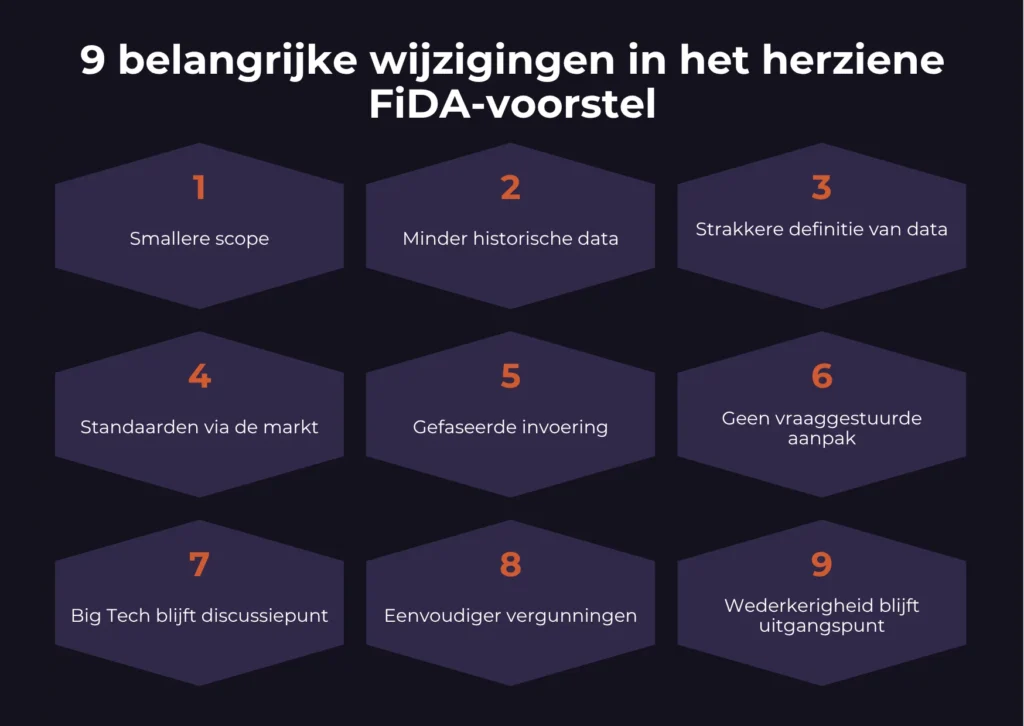
The non-paper introduces a series of targeted adjustments to make the framework lighter and more workable.
- Narrower scope
The scope is narrowed by excluding certain entities and datasets, such as credit rating agencies, large corporates and smaller financial institutions. Further exemptions are also being considered, for example for small insurance intermediaries.
Effect: less complexity and lower compliance burden. - Less historical data
The obligation to share historical data is being limited. Instead of broad datasets covering long periods, a phased approach with a shorter look-back period (for example two years) is being considered. Terminated contracts are often excluded.
Effect: lower costs and fewer privacy concerns. - Stricter definition of data
Only data that has not been substantially processed falls within the scope of FiDA.
Effect: protection of enriched or proprietary data and preservation of competitive advantage. - Standards through the market
The development of standards and APIs is partly left to the market, through European standardisation organisations (ESOs). At the same time, detailed EU obligations are being reduced.
Effect: greater flexibility and less top-down regulation. - Phased implementation
FiDA will be rolled out in three phases over approximately four years. Data sharing schemes will be established first, followed by mandatory data sharing.
After each phase, the European Commission will carry out an evaluation, with room for adjustments where necessary.
Effect: lower implementation risks and improved manageability. - No demand-driven approach
An alternative model — in which data sharing only takes place where there is market demand — is explicitly rejected.
Effect: prevents fragmentation between Member States and ensures that customer rights remain central. - Big Tech remains a point of discussion
The role of large technology companies has become firmly part of the agenda. Options range from excluding access to data to limiting licences.
Effect: no consensus yet, but it has become a central political discussion. - Simpler licensing procedures
For providers of financial information services, the licensing process will be simplified, including through the reuse of existing PSD2 information and fewer duplicate procedures.
Effect: lower administrative burden. - Reciprocity remains a key principle
An important principle remains intact: data holders will also gain access to data from others, provided the customer gives consent.
Effect: traditional financial institutions will become not only data providers, but also data users.
Conclusion
FiDA is not abandoned, but it is being recalibrated. The European Commission is moving towards a more pragmatic approach that prioritises feasibility and political support.
The balance is shifting towards a model that is less burdensome for market participants, while maintaining the core principle of mandatory, standardised data sharing. This remains the main source of political tension in the period ahead.