
In November 2025, the financial industry achieved a significant milestone by migrating cross-border payment instructions from the MT standard to ISO 20022. This transition did not happen overnight. It has been a long journey for financial institutions worldwide since 2018, when the decision to adopt ISO 20022 globally was first made. After the significant milestone in November 2025, can banks across the globe finally breathe a sigh of relief, or do they need to mobilise to be ready in time for the next milestones of the CBPR+ roadmap?
To delve into what this means for financial institutions worldwide and what comes next, we spoke with Marc Cameron, who was the ISO 20022 Global Programme Expert at Swift. Projective Group consultants worked with Marc to push the global financial community towards the global ISO 20022 standard for the past 4 years. In this interview, we explore the strategic benefits of ISO 20022 for financial institutions, the challenges banks worldwide face and the milestones that will shape the next phase of adoption.
Harmonisation of messaging standards as the initial value of ISO 20022
The migration to the ISO 20022 financial messaging standard was initially driven by regulators such as the European Central Bank, the Bank of England and the Federal Reserve. Later, Swift, as the global banking cooperative, took the lead in driving the worldwide transition to the ISO 20022 standard.
Marc Cameron reflects on the multi-standard set-up in the financial industry before the adoption of ISO 20022: “At that point in time, market infrastructures were saying: We all have different legacy formats for our financial institutions to send messages to us locally. It’s easy, but an institution like Citi or JP Morgan or Standard Chartered and a global bank like HSBC, has to format domestic payments in 20-40 different formats.”
Misalignment among standards leads to higher maintenance costs, reduced interoperability between cross-border and domestic payments and the ongoing need to upskill personnel in the operational domain.
For these global transaction banks operating in more than 100 countries, this means complying with a range of messaging standards and market practices. Misalignment among standards leads to higher maintenance costs, reduced interoperability between cross-border and domestic payments and the ongoing need to upskill personnel in the operational domain.
Challenges and opportunities in ISO 20022 adoption
Despite many financial institutions having formally migrated, some banks still rely on translation tools, while others still replicate MT data fields in ISO 20022. CBPR+ migration gives banks an opportunity to reassess the best practices highlighted in the PMPG guidelines for rich and structured data. To achieve it, banks must become ISO-native. In the long run, ISO-native banks will deepen their understanding of customer demands.
In the decade when data has become the new gold and AI is taking over the financial services industry and beyond, banks have an opportunity to provide targeted offerings to their customers by leveraging rich and structured data.
As Marc describes: “An institution can take in those new ISO payments with all this additional data and say: We see that a lot of clients are coming to pay for mortgages in a specific region of a country. Maybe we, as a bank, should promote our home financing services more? We also see that many payments are being made to cover tuition for students studying abroad. So, all that analysis you can do with the data is what’s going to open the door to leveraging these bigger, more robust ISO messages.”
In the decade when data has become the new gold and AI is taking over the financial services industry and beyond, banks have an opportunity to provide targeted offerings to their customers by leveraging rich and structured data.
There are other challenges that financial institutions have faced, such as high costs, limited internal expertise and the complexity of modernising legacy infrastructure. Cameron reflects on these challenges: “I talked about a global transaction bank that is a member of 13-20 market infrastructures around the world. They may have 50 different back-office systems and have to worry about integrating them. So cost, and the expertise of the people who know the existing solution and can replace it with new technology have been some of the biggest challenges.”
Discover how the ISO 20022 & CBPR+ training from Projective Group can help financial institutions move beyond “like-for-like” migration and embrace the full potential of ISO 20022.
Next milestones of the CBPR+ roadmap
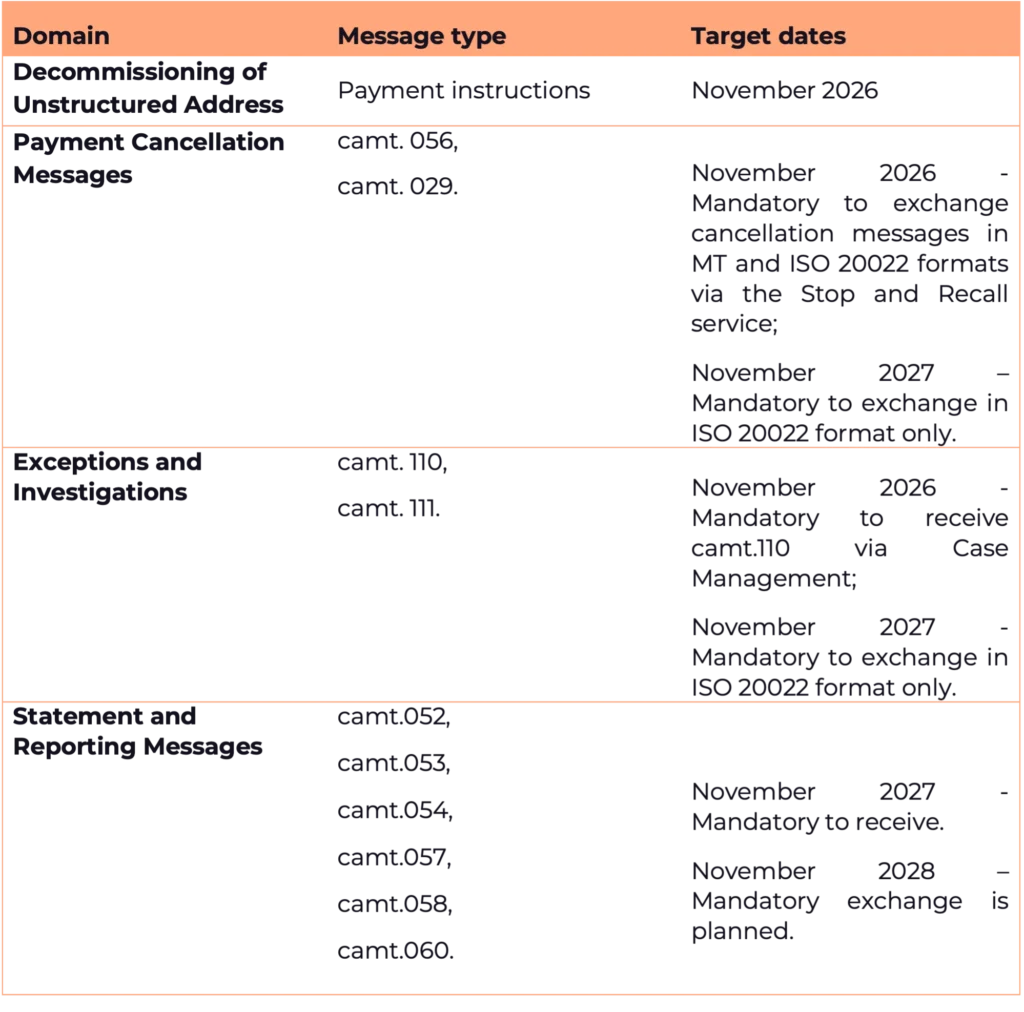
Although the coexistence period for payment messages has ended, it marks only the beginning of the CBPR+ ISO 20022 migration. Now is the time for financial institutions to proactively refine their implementations and prepare for upcoming mandatory changes, ensuring confidence in future compliance.
Banks that want to be compliant on time must prepare in advance for the next milestones of CBPR+ migration:
(Swift, 2025)
The advice that Marc gives to our readers: “Look ahead and don’t wait until the last minute. The sooner you start, the sooner you’ll learn and grow.” Marc elaborates with an analogy: “I want to start cooking Indian food. It’s like the sooner I start practising, the sooner I realise how many spices I can use and the sooner I start doing it, the better it’ll taste when I finally, you know, present it to someone at my home during a dinner party. So I think the sooner you get into using the new messages, get comfortable with them, walk away from the like-for-like mentality, and open your mind to the possibilities of what you could do with them, the better. I think that’s the way to look at the next steps for the next messages.”
Look ahead and don’t wait until the last minute. The sooner you start, the sooner you’ll learn and grow.
To ensure both financial messages and operations run as smoothly as the preparation of a perfectly spiced curry, timely preparation is essential.
Why banks should prioritise preparation for the exceptions & investigations domain now
Based on our in-depth product and industry insights, we are convinced that the biggest challenges and opportunities lie in migrating exception and investigation (E&I) messages. The migration is not only about format, going from free-format MTs to structured camt.110s and camt.111s, but also about moving from a bilateral, serial and inefficient setup to a centralised, orchestrated and optimised way of working. Through standardisation, better categorisation and more efficient investigation handling, banks can achieve significant operational gains.
The migration of E&I flows presents multiple challenges that both global and regional banks must address:
- A “like-for-like” migration approach cannot work, as it is impossible to translate MT 199 to equivalent camt messages due to their absence of structure.
- Data mapping is required to categorise previously free-format exceptions and investigations into defined investigation types and sub-types.
- There may be a significant shadow-IT footprint because MT 199 messages have been widely used for different purposes for decades.
- Operational processes will be significantly impacted, requiring thorough change management efforts to adapt the way of working across departments.
- Some exception and investigation categories, such as Unable to Apply, will no longer allow payment modifications, while others, such as Request for Information, will prohibit modifications to compliance-sensitive data.
It took almost seven years for the financial industry to migrate payment messages. Now, banks have less than two years to migrate exceptions and investigations.
Projective Group has played a key role in implementing and overseeing the CBPR+ migration and is actively involved in this E&I transition. We support banks in creating and implementing a customised change strategy that leverages the advantages of ISO 20022 by integrating our Payments, Transformation, and Data expertise.
About Projective Group
Established in 2006, Projective Group is a leading Financial Services change specialist.
We are recognised within the industry as a complete solutions provider, partnering with clients in Financial Services to provide resolutions that are both holistic and pragmatic. We have evolved to become a trusted partner for companies that want to thrive and prosper in an ever-changing Financial Services landscape.