The convergence of capital, technology and sustainability: Insights from the SuperNova CEO Debate

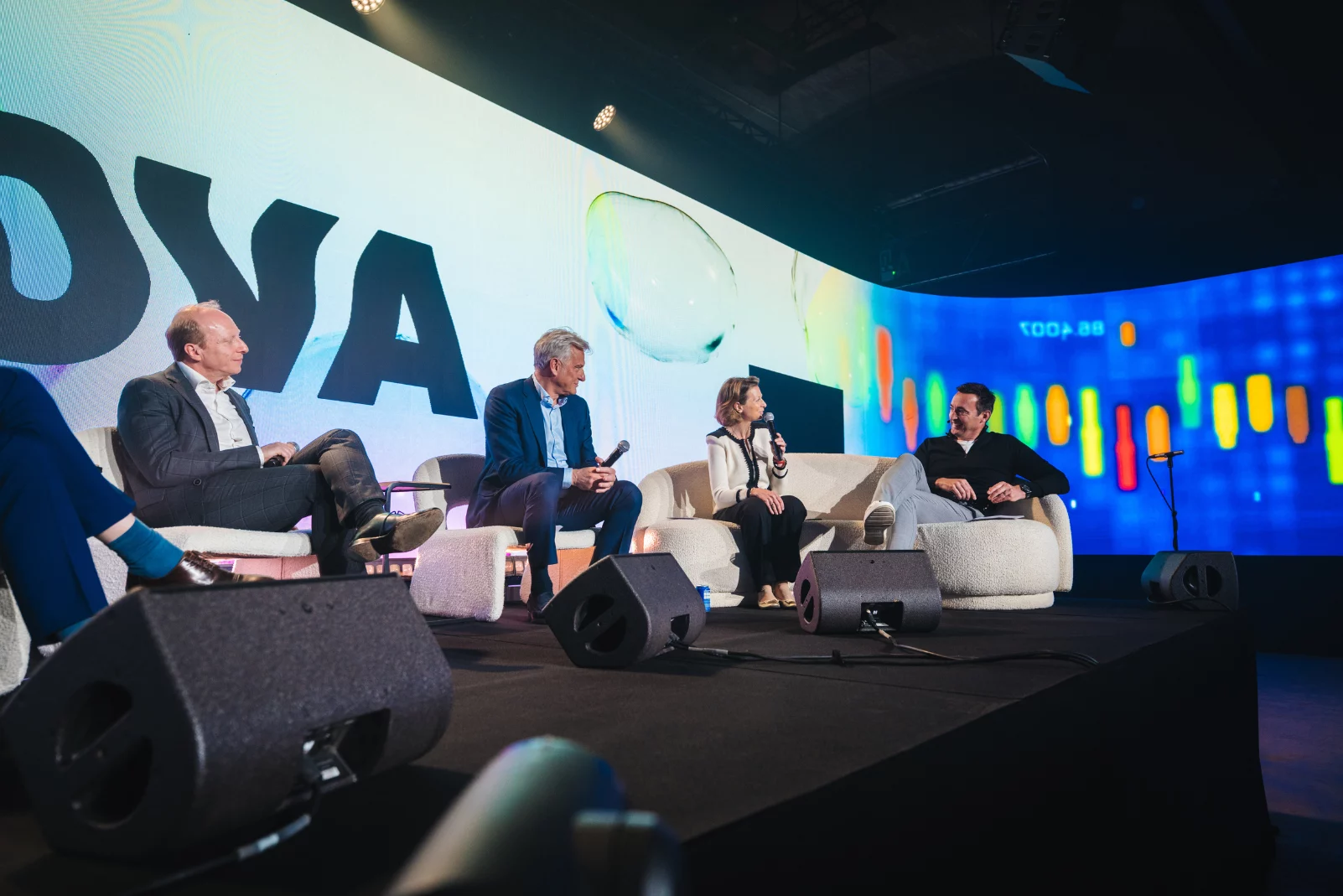
At this year’s SuperNova event, Projective Group Founder and CEO Stefan Dierckx hosted a conversation with four leaders from across the European financial landscape: Béatrice Dumurgier (Revolut Western Europe), Stefaan Decraene (Rabobank), Hans De Cuyper (Ageas) and Peter Adams (ING Belgium).
The discussion explored how digital disruption, regulatory fragmentation and the rise of AI are reshaping the sector. Below is a condensed view of the themes that matter most for financial institutions today.
Disruption in banking and insurance
The dynamic between digital challengers and long‑established institutions is shifting. Rather than two worlds competing, the panel described an industry learning from each other’s strengths.
Revolut challenges us on speed and scale, but we are not a ‘traditional bank’ anymore.
Digital players such as Revolut have built global platforms designed for scale, giving them a structural advantage in cost, speed and customer experience. Incumbent banks acknowledged this shift. As one CEO noted, “Revolut challenges us on speed and scale, but we are not a ‘traditional bank’ anymore.” Established institutions now accelerate their own digitalisation, drawing on their broader product ranges, deeper client relationships and long‑standing regulatory capabilities.
In insurance, the pattern is similar. Insurtechs bring fresh design thinking and fast execution, while established groups add decades of underwriting expertise, risk management and claims experience. Many see partnership models as the best way to combine these strengths. Across all speakers, four themes consistently emerged as markers of future success: speed, scale, simplicity and sustainability.
The challenge of a single European capital market
On the European Capital Markets Union, the panel aligned quickly: the ideas exist, the strategy is clear, but progress remains slow. As Stefaan Decraene put it, “We know what to do. It’s all on paper. The problem is making it happen.” Political complexity and fragmented regulation continue to limit the flow of capital across borders.
National supervisory frameworks still restrict the movement of capital inside large groups. This limits flexibility and keeps European equity markets shallow compared with those in the United States.
Banks described how national supervisory frameworks still restrict the movement of capital inside large groups. This limits flexibility and keeps European equity markets shallow compared with those in the United States. Insurers added that regulatory and tax frameworks often discourage long‑term or higher‑risk investments, even when significant savings pools are available.
Meanwhile, fintechs see both the promise and the limitations of technology. Revolut explained that “technology allows us to build pan‑European digital rails… but without harmonised regulation, it becomes a nightmare.”
The panel agreed that industry‑led initiatives can help, pointing to successful collaboration in payments. Shared infrastructure and standards could accelerate progress even while political agreement remains slow.
AI in financial services
The conversation around AI showed that the sector has moved far beyond experimentation. AI now supports core workflows, from credit assessment to fraud management, customer service and software development. Many organisations equip thousands of employees with tools such as Copilot and GitHub Copilot to help them work faster and make better decisions.
The conversation around AI showed that the sector has moved far beyond experimentation.
The panel also explored how AI will change customer behaviour. Stefaan Decraene from Rabobank highlighted that “our customers will also use agentic AI. That will change how they interact with banks.” If customers increasingly delegate financial decisions to AI assistants, institutions will need to rethink how they design their products, channels and data foundations.
A final and important point concerned Europe’s dependency on foreign technology providers. As one CEO stressed, “My biggest risk is not financial; it is operational and cyber. And on top of that, 70% of our IT spend goes to American vendors.” This dependency will only grow as AI and cloud adoption increases. The panel called for more European cooperation and investment in local capabilities to strengthen resilience and autonomy.
Closing thoughts
The debate highlighted a sector in transition. Digital challengers are setting new standards, incumbents are accelerating modernisation, and policymakers are navigating the complexities of building a unified European market. At the same time, AI is rapidly becoming an integral part of how financial services operate and compete.
At Projective Group, we see these themes every day in our work with clients. Progress comes from clarity, collaboration and pragmatic execution. Whether shaping strategy, delivering complex transformation or building long‑term capability, we help financial institutions turn these emerging themes into trusted, tangible solutions that deliver impact.
About Projective Group
Established in 2006, Projective Group is a leading financial services consultancy. We are recognised across the European industry for turning complex challenges and emerging themes into clear, pragmatic solutions. With deep roots and trusted relationships in financial services, we bring hands‑on expertise across key domains. We support the full journey of change: shaping strategy, delivering complex transformation or building long‑term capability through managed services, staffing and training. Our purpose is simple: to empower financial services to shape the future of wellbeing, prosperity and innovation.