EU Anti-Money Laundering Package Alert: Where AI Can Help (and Where It Can’t)




Over the coming years, the current Dutch Anti-Money Laundering and Counter-Terrorist Financing Act (Wwft) will be replaced by new European anti-money laundering regulations. This so-called EU AML package consists of several legislative instruments, including the AMLR, AMLD6 and AMLA Regulation. In parallel, the EU AI Act has also (partially) entered into force, setting out rules for the use of artificial intelligence within the EU. The combination of these two regulatory frameworks presents both opportunities and risks for financial institutions. Sound data management and data quality are becoming increasingly critical.
Where are the opportunities?
Artificial intelligence (AI) offers powerful tools to detect and prevent money laundering. For instance, AI can identify unusual transaction patterns in real time, or use machine learning algorithms to analyse client data, verify documents, and build risk profiles. This enables institutions to comply with the requirements of the EU AML package more efficiently and effectively.
Compared with the Wwft, the EU AML package places greater emphasis on a risk-based approach, which requires enhanced attention to high-risk clients and transactions, as well as keeping risk assessments up to date and dynamic. Reliable data is essential for this.
The new European authority AMLA (Anti-Money Laundering Authority) will require financial institutions to provide more frequent and more detailed (data) reporting than under previous national legislation such as the Wwft. This means that institutions must supply information on a structural basis, in line with specific technical standards. This obligation also applies to institutions not under AMLA’s direct supervision. AI can help institutions meet the increased reporting burden by producing reports that are consistent, explainable and scalable, with fewer errors, greater speed and higher efficiency.
What are the risks?
The use of AI also entails certain risks:
- AI systems may perform risk assessments based on profile data, potentially leading to discrimination against certain groups or unfair exclusion. The AI Act prohibits the ranking of individuals based on social behaviour or personal characteristics. Discrimination is also high on the regulators’ agenda.
- AI models used for client due diligence or risk assessment may operate as so-called “black box” systems: the machine makes a decision, yet it is unclear exactly how or why it reached that decision. Institutions, however, remain fully responsible for the final decision and must be able to justify and evidence it.
- Human oversight remains a crucial element in the use of AI. Because AI systems often provide convincing and error-free outputs, they may create an impression of expertise. In reality, mistakes still occur regularly. It is therefore essential that AI-generated output is always reviewed by someone with the necessary knowledge and experience, so that incorrect assessments can be corrected and potential harm mitigated.
Projective Group’s conclusion
The combination of the EU AML package and the AI Act calls for a fundamental review of data management. Transparency, traceability and governance are becoming even more important. By investing now in data quality, AI accountability and compliance architecture, institutions can not only mitigate risks but also seize opportunities for data-driven innovation.
The two key requirements are:
- AI in compliance and risk assessment must meet ethical and transparency standards; and
- Institutions are explicitly responsible for overseeing AI use within AML processes, and must critically assess its reliability, bias and impact on customers.
What can Projective Group do for you?
- We assist in interpreting regulations and implementing AI systems that comply with the EU AML package and the AI Act;
- We establish appropriate policies and governance frameworks;
- We perform audits and validations;
- We provide training and education;
- We support data management and optimisation, with or without the use of AI.
Status and timelines
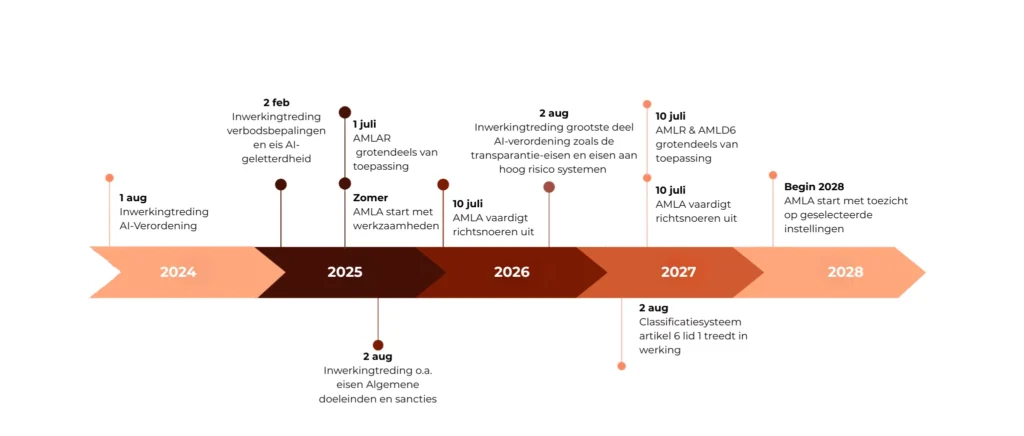
We closely monitor all developments and will keep you informed through our website and monthly newsletter.
Would you like to stay up to date with the latest AML developments? Subscribe to our newsletter today.